Official product information
How Does SodaBoost Work? A Look at Its Nine Ingredients
What this product is sold to do, set against what NCCIH, NIH ODS and FDA actually publish about the nine ingredients printed on its panel.
Quick answer
SodaBoost works through its nine ingredients, with a focus on male energy, stamina and vitality.
Two have named research: tribulus terrestris, with a 2017 trial and a 2014 study, and ashwagandha, studied for fertility markers. No trial of the full formula has been published yet.
See the full list on the ingredients page.
01 What it is sold to do
What it is sold to do, and what the bottle claims
The claims live on the sales page, where the disclaimer lives too. That is the right way round, and it also tells you where to look.
The bottle makes no benefit claim at all. The front carries a helmet, a wordmark and the words 30 GUMMIES | DIETARY SUPPLEMENT, and the back carries directions, a warning, a storage line and the FDA disclaimer. Everything this product is sold to do is said somewhere else: the sales page positions it for male energy, stamina and vitality.
So this page does not ask whether the bottle’s claim holds up, because the bottle makes no claim. It asks the narrower question: the sales page positions this product for male energy, stamina and vitality — what does the federal record publish about the nine ingredients on the panel?
No trial of this formula has been published, so everything here is about the ingredients, and an ingredient result does not transfer to a finished product at a different amount in a different dose form. That is why the bounds from the blend page are carried into every section below.
5 of 9 ingredients with a federal consumer page
The one federal sentence about this whole category
NCCIH’s verdict covers the class rather than the product.
There is a federal page about this whole category, and it is the plainest sentence on this site. The National Center for Complementary and Integrative Health: “No complementary health approaches have been shown to be safe and effective for sexual enhancement or treating erectile dysfunction (ED).” That is a statement about every botanical sold for this purpose, not about this product in particular, and it is the sentence a buyer should read before any other.
That sentence is the spine of this page, so be precise about its scope. It is a statement about complementary health approaches as a class — every botanical, every blend, every gummy sold for this purpose — and not a finding about this product, which has never been studied. NCCIH adds the reason the class verdict reads that way: “Researchers have studied a variety of herbal remedies for ED, but the amount of research on each herb has been small, and much of the research has been done in animals rather than people.” Small studies, often in animals, rarely repeated.
Of the nine ingredients on this panel, five appear on a federal consumer page and four appear on none at all. Green tea and ashwagandha have full NCCIH pages. Caffeine has an FDA consumer update. L-arginine and tribulus terrestris each have a section in NIH ODS’s fact sheet on supplements for exercise and athletic performance. Muira puama, maca, catuaba and horny goat weed have nothing: no NCCIH page, no ODS fact sheet, no MedlinePlus entry. MedlinePlus withdrew its herb and supplement database on 29 July 2025, which closed the one federal-domain place a consumer could have looked them up.
Five of nine is better coverage than this category usually manages, and it is the ceiling on what anybody can tell you about this blend from a federal source. For the other four there is no page to quote in either direction.
02 The two with something behind them
The two ingredients with something behind them
A positive tribulus trial and a null one, in the same passage — and an ashwagandha finding about fertility markers.
Two of the nine have something specific attached to them, and both are carried with both halves, because printing one half of either would be dishonest.
Tribulus terrestris: a positive trial and a null one
Both halves have to be carried together, and this is the ingredient where that matters most. NCCIH cites a 2017 randomised controlled trial in 86 men in which “significant improvement in sexual function was observed with Tribulus terrestris compared with placebo” over twelve weeks — and, in the same passage, an earlier 2014 study in 30 men in which it “was not more effective than placebo on improving symptoms of ED or serum total testosterone.” NIH ODS, writing about performance rather than sexual function, is blunter: “There’s no scientific support for taking Tribulus terrestris supplements to improve exercise or athletic performance.” Tribulus is row eight of nine on this panel, which caps it at 5 mg.
Now add the amount. Tribulus is row eight of nine, below a row printed at 5 mg, so it is capped at 5 mg, while the 2017 trial ran twelve weeks on an extract at a research amount. A trial result does not travel down to an amount the trial never used.
Ashwagandha: a real finding about the wrong thing
Ashwagandha is the other ingredient with something behind it, and the detail matters. NCCIH: “There is some limited evidence that suggests that taking ashwagandha for 2 to 4 months may increase testosterone levels and sperm quality.” That is about testosterone and sperm quality — fertility markers, not about energy, stamina or sexual function. NCCIH’s own effectiveness verdict for ashwagandha names two conditions and neither is sexual: “Research shows that some ashwagandha preparations may be effective for insomnia and stress.” And it lists athletic performance among the things there is not enough evidence for. Ashwagandha is row six here, capped at 5 mg.
State it flatly, because it is the finding most often misread. Testosterone and sperm quality are fertility markers. They are not energy, not stamina, and not sexual function. A page that quotes that sentence under a heading about stamina has changed what it means. Ashwagandha is row six here, capped at 5 mg; NCCIH publishes a duration for those trials and no amount, so there is no figure to set the row against.
3 steps on the seller’s card
The seller’s three steps, and the six this site wrote instead
Follow label directions, product formula, daily routine. None of those is a mechanism.
The seller has its own account of how the product works, and it ships as a three-step card. It is reproduced here because it is a fair example of what this category offers.
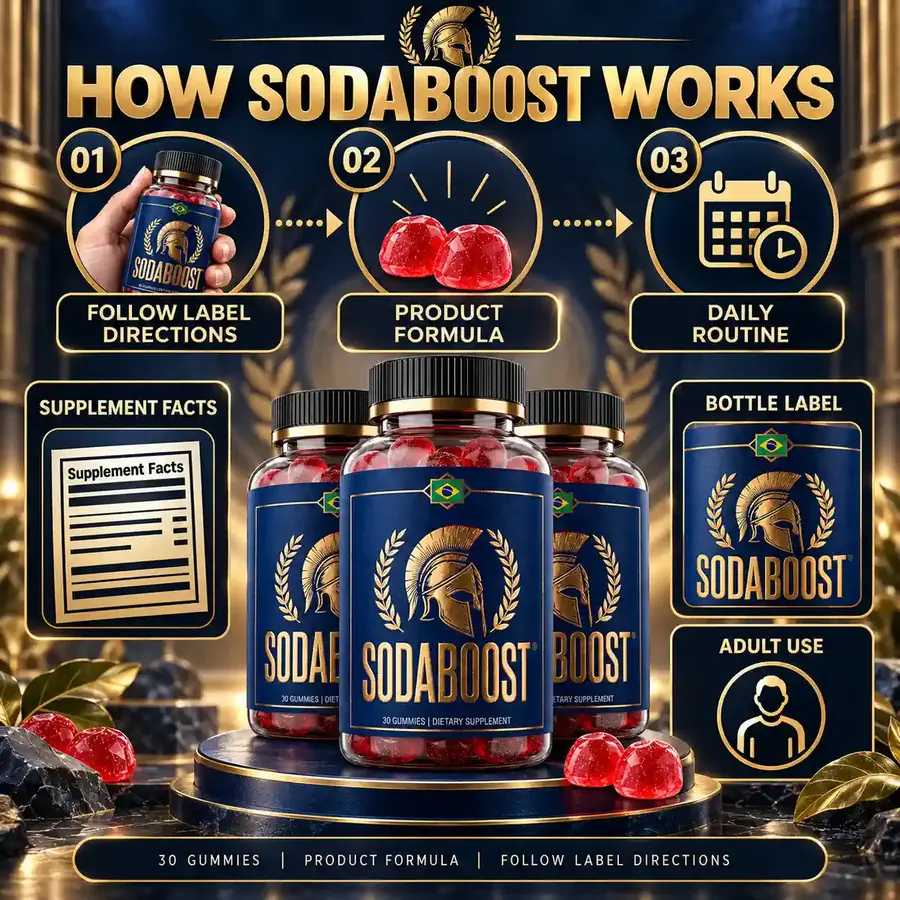
There is no criticism of the artwork in that; it is a well-made card. The problem is that a buyer who reads it knows exactly as much about how this product is supposed to act as one who did not. “Product formula” is not a mechanism; it is a noun.
The alternative is a method rather than a mood, and it is on the home page as six numbered steps: read the panel rather than the card, find the one printed amount, apply the ordering rule, bound the biggest row from the other end, compare it with something published, then read the price and the refund window. It works on any supplement, not just this one.
0 published trials of this formula
Three honest statements, and no fourth
What can be said, what cannot, and what would change it.
So where does that leave a buyer who wanted an answer? With three honest statements and no fourth.
First, nobody can tell you whether this product works: no trial of this formula exists, and the federal page about the category says no complementary approach has been shown safe and effective for it. Second, the ingredient evidence that does exist is thin, mixed, and attached, where an amount is published at all, to quantities hundreds to thousands of times larger than the panel permits. Third, the label is careful: it claims nothing on the bottle, it prints its warning, storage line and disclaimer properly, and it itemises the one figure that let this site do any arithmetic at all.
What would change this page
A randomised, placebo-controlled trial of this formula, at this amount, in this dose form, published where a reader can check it. Until then the useful question is whether anything on the label is a reason for you in particular to stop, and the seven that decide it are on the home page fit check. One federal sentence belongs last: “Tell your health care providers (including doctors, dentists, pharmacists, and dietitians) about any dietary supplements you’re taking.”
Questions
SodaBoost FAQ: how it works questions
Does SodaBoost work?
No trial of this formula has been published, so nobody can answer that from evidence. The nearest federal sentence is NCCIH’s: “No complementary health approaches have been shown to be safe and effective for sexual enhancement or treating erectile dysfunction (ED).”
Does the tribulus in SodaBoost do anything?
NCCIH cites a 2017 trial in 86 men where tribulus beat placebo over twelve weeks, and a 2014 study in 30 men where it did not. Both belong in the same sentence. Either way the trials used research amounts and this row is capped at 5 mg.
Does ashwagandha help with energy?
NCCIH’s effectiveness verdict for ashwagandha names insomnia and stress, and lists athletic performance among the things there is not enough evidence for. Energy is not named on the page either way.
Can SodaBoost treat erectile dysfunction?
No supplement may be sold to treat it, and none has been shown to. If the difficulty is new or getting worse, that is a reason to see a clinician: it can be an early sign of a cardiovascular or hormonal problem that is worth finding.
Is there anything in SodaBoost that is not on the label?
Nothing this desk can see, and nothing anybody can see from outside: FDA notes that with undeclared ingredients “Consumers can’t tell whether a product contains these ingredients because they’re not listed on the product label.” That is a statement about the category, not a finding about this product.
What would prove SodaBoost works?
A randomised placebo-controlled trial of this formula, at this amount, in this dose form, published somewhere a reader can check. Not an ingredient trial at a different amount, and not a review block.
References
Sources for this page
- National Center for Complementary and Integrative Health. Dietary Supplements Marketed for Weight Loss, Bodybuilding, and Sexual Enhancement: What the Science Says. www.nccih.nih.gov. Accessed October 7, 2026.
- National Center for Complementary and Integrative Health. Ashwagandha: Usefulness and Safety. www.nccih.nih.gov. Accessed October 7, 2026.
- NIH Office of Dietary Supplements. Dietary Supplements for Exercise and Athletic Performance — Consumer. ods.od.nih.gov. Accessed October 7, 2026.
- U.S. Food and Drug Administration. Sexual Enhancement and Energy Product Notifications. www.fda.gov. Accessed October 7, 2026.
- U.S. Food and Drug Administration. Example product notification: hidden drug ingredients. www.fda.gov. Accessed October 7, 2026.
- U.S. Food and Drug Administration. Questions and Answers on Dietary Supplements. www.fda.gov. Accessed October 7, 2026.
Next
Keep reading
The 82 mg, derived
Why four rows are capped at 5 mg, and why that caps what any trial can say.
Read it →Claimed against evidenced
Each claimed benefit set beside what the federal record actually publishes.
Read it →The cautions that exist
Interactions and side effects from the five ingredients that have a page.
Read it →Order SodaBoost from the official page
30 gummies a jar, one a day, thirty days a jar. A proprietary blend of 82 mg holding nine ingredients, of which one carries a figure of its own. 60 days to change your mind. Sales line +1 (302) 200-3480.
Price shown at checkout · 60-day window, no start point printed · ships from inside the US · sales line +1 (302) 200-3480