Official product information
The SodaBoost Blend: 82 mg, Nine Ways, One Printed Figure
The whole derivation in one place: 82 mg, nine members, one printed figure, and the floor and ceiling that figure gives every other row on the panel.
Quick answer
The panel declares a Proprietary Blend of 82 mg holding nine ingredients and prints one amount inside it: caffeine, 5 mg, in row five. FDA requires members to be listed in descending order of weight, so rows six to nine are each 5 mg or less and row one sits between about 14 mg and 62 mg. The 567 mg dry-powder footnote describes the blend, not a row.
01 The blend line, and the rule on it
One line, nine ingredients, and a rule about the order
The panel declares the total and withholds the parts, which is permitted. It cannot withhold the order.
The Supplement Facts panel declares one line that decides everything else about this product: Proprietary Blend, 82 mg, and indented beneath it, nine ingredients. Muira puama extract, maca extract, catuaba extract, green tea extract, caffeine (5 mg), ashwagandha, L-arginine, tribulus terrestris and horny goat weed extract. One number for all nine, and only the caffeine carries a figure of its own.
That is legal, and it is worth saying so plainly before anything else. FDA’s own labeling guide tells a manufacturer to identify the blend, to put “the total weight of all ‘other dietary ingredients’ contained in the blend” on the same line, and to list the members “in descending order of predominance by weight”. It does not require the individual weights. This panel does exactly what the rule asks. The finding on this page is not that the panel breaks a rule. It is what the rule permits a careful reader to work out anyway.
The sentence this entire page rests on is the third requirement in that guide: “Indented underneath the name of the blend, you must list the “other dietary ingredients” in the blend, either in a column or linear fashion, in descending order of predominance by weight.”
Read it slowly. The order is not a stylistic choice and it is not alphabetical. It is a quantity statement written as a sequence instead of as a column of numbers, and it binds the label in exactly the way the printed total does.
5 mg printed in row five of nine
The derivation, with the working shown
Everything below the printed row is capped by it; everything above it is bounded by what is left.
Caffeine is printed at 5 mg, and it is listed fifth of nine. Because the panel must run in descending order of weight, every ingredient listed after the caffeine must weigh the same or less than it. So ashwagandha, L-arginine, tribulus terrestris and horny goat weed extract can each be no more than 5 mg. Not approximately. At most. That is not an estimate and it is not an accusation; it is what this label says once you apply the rule it was printed under.
Itemising one member when the rule did not require it is the most useful thing on this bottle, and it is to the label’s credit. A blend with no itemised figure in it at all gives a reader nothing to work from.
The same rule bounds the other end. The three rows above the caffeine must each be at least 5 mg, so they account for at least 15 mg between them, and the first-listed ingredient — muira puama extract — can be no more than 62 mg (82 total, less 5 for the caffeine, less at least 5 each for rows two, three and four). The floor is arithmetic too: if row one were under about 14 mg, every row beneath it would be smaller again, the last four would still be capped at 5 mg each, and nine rows could not add up to 82 mg at all. So the honest range for the biggest ingredient in this product is somewhere between about 14 mg and 62 mg, and the four smallest are 5 mg or less apiece. The three rows in between are bounded too, and more tightly than row one, because they have to share what is left: row two is at most 33.5 mg, row three at most 24 mg and row four at most 19.25 mg.
Both directions are arithmetic rather than judgement, so here is the working in full: a floor and a ceiling for every row, one cell printed and the rest derived.
02 The working, tabulated
A floor and a ceiling for every row
Nine rows, eighteen bounds, one printed figure behind all of them.
| Row | As printed | Floor | Ceiling | How the bound is reached |
|---|---|---|---|---|
| 1 | Muira Puama Extract | about 14 mg | 62 mg | 82 less 5 for the caffeine, less at least 5 each for rows two to four. The floor is the least that lets nine capped rows reach 82 mg. |
| 2 | Maca Extract | 5 mg | 62 mg | Above the printed line, so at least 5 mg; no heavier than row one. |
| 3 | Catuaba Extract | 5 mg | 62 mg | At least 5 mg; no heavier than row two. |
| 4 | Green Tea Extract | 5 mg | 62 mg | Last row above the printed line. At least 5 mg; no heavier than row three. |
| 5 | Caffeine (5mg) | 5 mg | 5 mg | Printed. The only figure inside the blend, and the hinge the table turns on. |
| 6 | Ashwagandha | not given | 5 mg | Below the printed line, so 5 mg at most. The panel gives no floor for this row or any beneath it. |
| 7 | L-Arginine | not given | 5 mg | Below the line; no heavier than row six. |
| 8 | Tribulus Terrestris | not given | 5 mg | Below the line; no heavier than row seven. |
| 9 | Horny Goat Weed Extract | not given | 5 mg | Last of nine, so the lightest, capped twice over. |
Nothing in the Floor or Ceiling column is a measurement or an estimate. Each is what the label permits once its own ordering rule is applied.
Keep the rule rather than the numbers. On any proprietary blend, find a row that carries its own figure, and every row listed below it is capped by that figure. Most blends never give you one. This one did, and that single printed 5 mg is the most useful thing on the bottle.
The interactive version is the ring splitter on the home page. Move the first-listed ingredient anywhere across its range: the nine rows always total 82 mg, and the last four never rise above 5 mg, because the ordering rule will not let them.
6 named and photographed on the marketing card
The card that names six of the nine
The best-looking surface in the pack leaves three ingredients out.
Three surfaces in the supplied material name these ingredients and no two agree: the sales FAQ names three, the marketing card names six, the panel names nine. The middle one is worth looking at directly, because it is the most polished thing in the pack. It is handsome, it is specific, and it is six ninths of the truth.
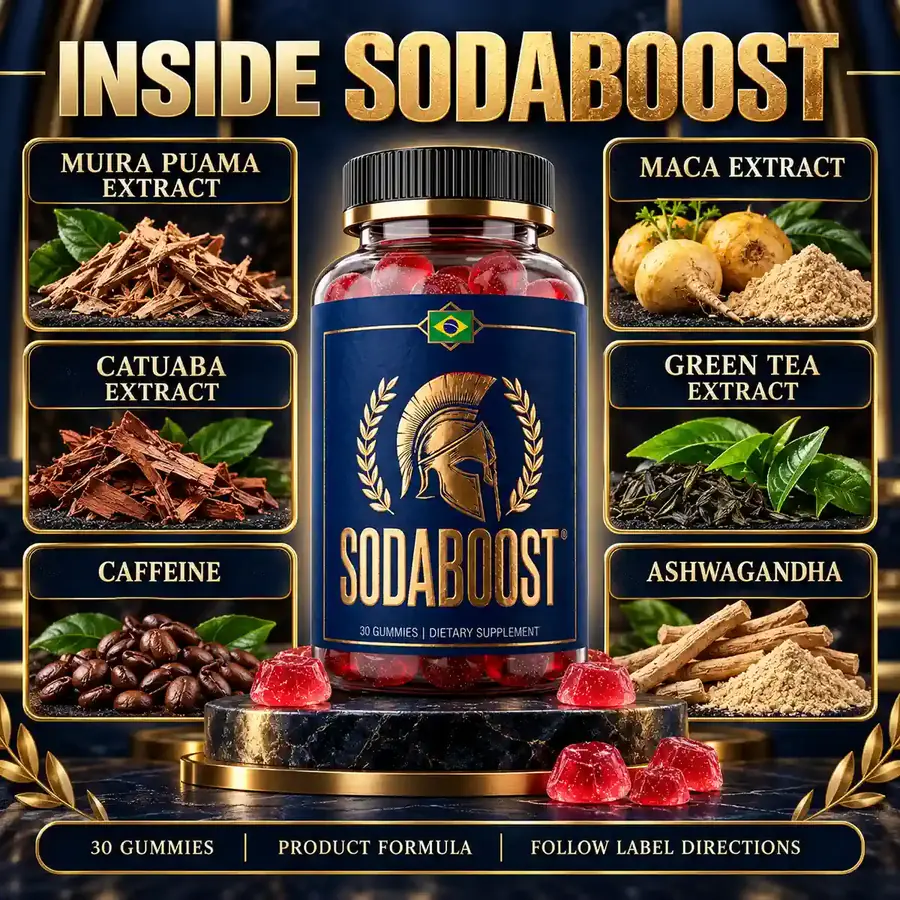
The direction matters. The marketing is not adding ingredients that are not in the bottle — it is quietly leaving out ingredients that are. L-arginine, tribulus terrestris and horny goat weed extract appear on the panel and on no other surface at all: not in the sales FAQ, not on the card, and not among the six ingredient photographs. A buyer who reads only the marketing does not learn that the product contains them. That is the opposite of the failure the federal warning pages describe, and it is still a gap worth closing yourself by reading the panel.
The direction is the point. Nobody here is adding an ingredient that is not in the bottle; the marketing is leaving out three that are, and one of those three carries the sharpest federal safety note on the panel. Press each surface on the home page counter and watch the names drop out.
03 The dry-powder footnote
567 mg of dry powders, and why it rescues no single row
A whole-blend equivalence with no per-ingredient ratio behind it.
One footnote on the panel reads, at a glance, like an answer to everything above: “equivalent to approximately 567mg of dry powders.” Eighty-two milligrams of extract described as equivalent to about 567 mg of dry plant material is a ratio of roughly 6.9 to 1, and it is an ordinary thing for an extract label to print.
It rescues no single row, and the reason is structural rather than suspicious. The footnote is attached to the blend line, not to any ingredient. It describes all nine members together at one average and prints no ratio for any one of them, so there is no way to carry it down to a row. If the muira puama were a 10:1 extract and the maca a 4:1, the blend could still average 6.9:1 and the footnote would read identically.
One footnote is the label’s answer to all of this: “** equivalent to approximately 567mg of dry powders.” It describes the whole blend at roughly 6.9 to 1, and it prints no ratio for any single ingredient, so it rescues no individual row. It is also worth doing the division: even 567 mg split nine ways is about 63 mg each, and the blend is not split nine ways evenly — the panel’s own ordering rule says it is not.
So the honest way to hold it: a real piece of information about how the extract was made, the kind of note a careful label prints, and it changes none of the bounds in the table above.
2–20 g the studied range for one ingredient alone
Eighty-two milligrams, next to something
A number only means something beside another number.
The only way to read 82 mg is next to something. NIH ODS discusses L-arginine at 2 to 20 grams a day and notes that “A nutritious diet supplies about 4 to 5 grams a day”. The low end of that range is 2,000 mg, so this entire nine-part blend is about one twenty-fourth of it — and the L-arginine row inside the blend, capped at 5 mg, is about one four-hundredth. FDA cites 400 mg of caffeine a day for most adults; this gummy has 5 mg, one eightieth of it. For ashwagandha, NCCIH gives a duration — two to four months — and does not publish the amounts those trials used, so there is no comparison to draw there.
None of that is a claim that the product does nothing; this desk cannot measure what a product does. It is the observation that the published amounts and the label amounts are not in the same range. For the one ingredient with a published studied range — L-arginine, which NIH ODS discusses at two to twenty grams a day, against a row the ordering rule caps at 5 mg — the gap is between two and three orders of magnitude. What would close it is not complicated, and the seller holds all of it: per-ingredient amounts on the panel, or an extract ratio against each row.
Questions
SodaBoost FAQ: the 82 mg blend questions
What is a proprietary blend?
A named mixture whose total weight must be printed but whose individual amounts need not be. FDA requires the members to be listed “in descending order of predominance by weight”, which is what makes any of this derivable.
How much of each ingredient is in SodaBoost?
Only one amount is printed: caffeine, 5 mg. Everything else can be bounded but not stated. Because FDA requires blend members to be listed in descending order of weight and caffeine is fifth, the four ingredients after it are each 5 mg or less.
What does “567mg of dry powders” mean on the SodaBoost label?
It is an extract-ratio footnote: the 82 mg of extract is described as equivalent to about 567 mg of raw dried plant material, roughly 6.9 to 1. It applies to the whole blend and no per-ingredient ratio is printed, so it rescues no individual row.
Is 82 mg enough to do anything?
It is small against every published figure this desk could find. NIH ODS discusses L-arginine alone at 2 to 20 grams a day and notes a normal diet supplies four to five grams; this entire nine-part blend is 82 milligrams.
Will I feel anything from 5 mg of caffeine?
Most people will not. FDA puts 400 mg at two to three 12-ounce cups, which makes five milligrams somewhere between a twenty-seventh and a fortieth of one cup. FDA notes “there is wide variation in both how sensitive people are to the effects of caffeine”, so small is not the same as nothing for everybody.
References
Sources for this page
- U.S. Food and Drug Administration. Dietary Supplement Labeling Guide: Chapter IV. Nutrition Labeling. www.fda.gov. Accessed October 7, 2026.
- NIH Office of Dietary Supplements. Dietary Supplements for Exercise and Athletic Performance — Consumer. ods.od.nih.gov. Accessed October 7, 2026.
- U.S. Food and Drug Administration. Spilling the Beans: How Much Caffeine is Too Much?. www.fda.gov. Accessed October 7, 2026.
- National Center for Complementary and Integrative Health. Ashwagandha: Usefulness and Safety. www.nccih.nih.gov. Accessed October 7, 2026.
- NIH Office of Dietary Supplements. Dietary Supplements: What You Need to Know. ods.od.nih.gov. Accessed October 7, 2026.
Next
Keep reading
The nine dossiers
Each ingredient in printed order, with its derived bound and its federal page.
Read it →The panel, line by line
Everything printed on the back of the bottle, transcribed and explained.
Read it →The claim and the federal record
What the product is sold to do, set against what the federal pages publish.
Read it →Order SodaBoost from the official page
30 gummies a jar, one a day, thirty days a jar. A proprietary blend of 82 mg holding nine ingredients, of which one carries a figure of its own. 60 days to change your mind. Sales line +1 (302) 200-3480.
Price shown at checkout · 60-day window, no start point printed · ships from inside the US · sales line +1 (302) 200-3480